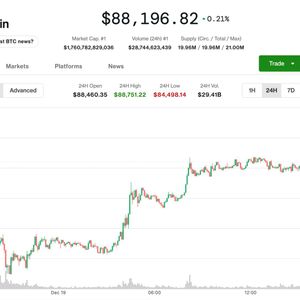
BitcoinWorld Bitcoin Price Plummets: Key Reasons Why BTC Fell Below $88,000 The cryptocurrency market is experiencing a significant shift as the Bitcoin price has fallen below the crucial $88,000 mark. According to Bitcoin World market monitoring, BTC is currently trading at $87,946.82 on the Binance USDT market. This sudden movement has left many investors wondering about the underlying causes and the potential implications for their portfolios. Let’s break down what’s happening. Why Did the Bitcoin Price Drop Below $88,000? Market corrections are a normal part of any financial asset’s lifecycle, and Bitcoin is no exception. The recent dip in the Bitcoin price can be attributed to a confluence of factors. Firstly, profit-taking by short-term traders after a period of gains often creates selling pressure. Secondly, broader macroeconomic concerns, such as interest rate anxieties, can trigger risk-off sentiment across all speculative assets, including crypto. Finally, technical analysis indicates that the $88,000 level was a key psychological support; breaking through it likely accelerated the sell-off. What Does This Mean for Bitcoin Investors? For long-term holders, often called ‘HODLers,’ this price action may be viewed as a temporary volatility event. However, for active traders, it signals a need to reassess strategies. Here are three immediate considerations: Risk Management: Ensure your stop-loss orders are updated to protect your capital from further downside. Market Sentiment: Monitor trading volume and social sentiment to gauge whether this is a short-term correction or the start of a deeper trend. Dollar-Cost Averaging (DCA): For those looking to accumulate, a lower Bitcoin price can present a strategic DCA opportunity. How Does This BTC Movement Compare to Historical Trends? Historically, Bitcoin has experienced numerous drawdowns of 20% or more during its bull markets. These pullbacks are often followed by periods of consolidation before the next leg up. Therefore, while watching the Bitcoin price fall can be unsettling, it’s essential to maintain perspective. The fundamental drivers of Bitcoin adoption—such as institutional investment and its role as a digital store of value—remain intact. This current movement is a reminder of the asset’s inherent volatility. Actionable Insights for Navigating the Volatility Instead of reacting emotionally to the chart, consider these practical steps. First, diversify your crypto holdings beyond just Bitcoin to spread risk. Second, use reliable on-chain data and analysis, not just price charts, to inform your decisions. Finally, remember that successful investing is about discipline. Setting clear entry and exit points based on your research, not fear or greed, is crucial when the Bitcoin price makes a sharp move. In conclusion, the drop below $88,000 is a significant technical event that warrants attention. However, it does not necessarily invalidate the long-term bullish thesis for Bitcoin. Market cycles are defined by both explosive growth and healthy corrections. By understanding the reasons behind the move and maintaining a disciplined approach, investors can navigate this volatility with greater confidence. The key is to focus on the underlying technology and adoption trends, not just the daily fluctuations in the Bitcoin price . Frequently Asked Questions (FAQs) Q: Is the Bitcoin price drop a sign of a bear market? A: Not necessarily. A single drop below a support level is a common occurrence in bull markets and is often considered a healthy correction before the next upward move. Q: Should I sell my Bitcoin now? A> That depends entirely on your investment strategy and risk tolerance. Long-term holders typically advise against selling during downturns, while traders might use it as an exit signal based on their technical analysis. Q: What is the next major support level for BTC? A> Analysts will be watching previous resistance-turned-support zones, often around $84,000 and $80,000, as potential areas where buying interest could return. Q: Could the Bitcoin price fall further? A> Yes, all asset prices can always move in either direction. Continued negative macroeconomic news or large-scale liquidations could push the price lower. Q: Is this a good time to buy Bitcoin? A> For investors using a Dollar-Cost Averaging (DCA) strategy, a lower price can be advantageous. However, trying to ‘catch the falling knife’ by timing the exact bottom is extremely risky. Q: How does this affect other cryptocurrencies? A> Bitcoin often sets the tone for the broader crypto market. A sustained drop in BTC’s price typically leads to correlated downward movement in altcoins, often with even greater intensity. Found this analysis of the Bitcoin price movement helpful? Share this article on your social media to help other investors stay informed and navigate the market’s twists and turns with clarity. Knowledge is power, especially in volatile markets! To learn more about the latest Bitcoin trends, explore our article on key developments shaping Bitcoin price action and long-term institutional adoption. This post Bitcoin Price Plummets: Key Reasons Why BTC Fell Below $88,000 first appeared on BitcoinWorld .