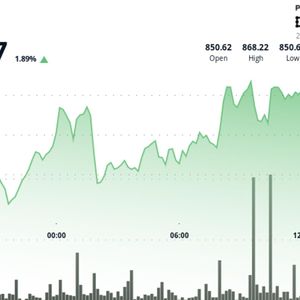
Summary BTC's price is strongly correlated with expected changed in money supply. With M2 equilibrium reached and limited QE prospects, I expect BTC to deprecate, targeting a $30,000 bottom. Chairman Powell's comments at the last FOMC meeting weren't an indication of QE. In fact, with 350 basis points of rate-cuts room left, QE won't be initiated anytime soon. With a historical standard deviation of ~149% and limited near-term upside, investors will rotate out of BTC —something dominance charts already indicate is underway. A primary risk to my thesis is one-off events that provide tailwinds for BTC; however, I argue that those events are themselves influenced by M2. My thesis applies not only to IBIT but to all other Bitcoin ETFs as well, including ProShares Bitcoin ETF (BITO), Fidelity Wise Origin Bitcoin Fund (FBTC), and Grayscale Bitcoin Trust (GBTC). “Bitcoin is a bubble, a speculative asset!” Words usually spoken by those jaded because of persistent headlines on Bitcoin’s ( BTC-USD ) dramatic price movements. BTC’s a risky asset, yes, but it’s also swiftly gaining acceptance as a traditional asset. One of the primary reasons for my assertion is the numerous numbers in this report , the most eye-catching of which is that an estimated ~40% of the American population now owns BTC. Furthermore, another article indicates that the U.S. government is among the top 10 holders of BTC and that U.S. Spot ETFs, collectively, now hold more BTC than the coin’s founder, Satoshi Nakamoto. One could argue that just because everyone is jumping on the bandwagon doesn’t imply it’s a great investment. Surely, if the crowd is always right, then investing is akin to an election, and trending assets would have the best risk-return profile. A reasonable argument, definitely. Through this article, however, I’ll demonstrate that BTC’s prices are, now more than ever, driven by macroeconomic factors, rather than “feelings and opinions” of the crowd. In other words, if investors use the right data, their ability to identify BTC’s peaks and bottoms will improve manifold. One such macroeconomic metric, and the core of this thesis, is the U.S. Economy’s Money Supply (M2). What Is IBIT? But before that, a quick introduction to the iShares Bitcoin Trust ETF ( IBIT ) for those not well-acquainted with the ETF. According to the fund’s fact sheet : The iShares Bitcoin Trust ETF seeks to reflect the performance of the price of bitcoin. The Trust offers exposure to bitcoin through an exchange-traded product, simplifying the operational and custody complexities of holding bitcoin directly. According to data on Morningstar, the fund’s total returns since inception are 42.57%, attained with a standard deviation of 88.62 and a Sharpe ratio of 0.67. Interestingly, IBIT came into existence on January 5, 2024, and has since managed to attract $66.02B in assets, a feat placing it among the Top 100 ETFs based on AUM. And only 9 places lower than arguably the most popular ETF on Seeking Alpha, the Schwab US Dividend Equity ETF ( SCHD ), which has $72.80B in AUM. Once again, supporting my argument that BTC is quickly attaining the ranks of a traditional asset class. BTC and M2 Changes Below is a chart that maps BTC against changes in M2. A high-level analysis reveals a strong correlation between changes in M2 (M2C) and BTC prices, especially since 2020. BTC-USD vs M2 YoY % Change (Weekly, Sep 2014 – Nov 2025) (Author's Work (Date from Yahoo! and FRED)) Specifically, the M2C curve experienced a strong pivot in March 2020, due to the Fed’s response to the COVID crisis when it executed the most aggressive quantitative easing program since its inception. Six months later, BTC prices started rallying to reach an all-time high (at that time) of roughly $65,000. But at the start of 2021, M2C stated sinking. A numerically foreseeable event because of the inevitability of base effects coming into play, following M2C’s huge surge in 2020. Those effects, however, started fading by June 2021, manifesting as a flat M2C curve for the last two quarters of 2021. M2C’s stabilization/flattening was short-lived because the effects of the Fed’s QE tapering program began to kick in at the start of 2022, and introduced renewed pressures on M2C, leading to another downward leg. A trajectory that attained further momentum when the Fed transitioned to quantitative tightening in June 2022 . By the end of October 2022, M2C turned negative. BTC prices began to tank at the end of 2021, affirming the strong correlation between BTC prices and M2C. Readers, at this juncture, should ask: was the cause of that price depreciation due to the first pivot in early February 2021 or the second pivot at the start of 2022? In my view, it’s the first because markets function on expectations rather than events. In early 2021, expectations of further QE had pretty much extinguished because the Fed had front-loaded money injections, and continuing with such aggressive QE actions was not sustainable. Then, only three years after the pandemic, in March 2023, the Silicon Valley Bank Collapsed, which, as some readers may recall, prompted the Fed to introduce the Bank Term Funding Program (BTFP) to stabilize not just the SVB but the entire U.S. banking industry. The BTFP was a liquidity injection that led to a directional change in M2C even though QT was still active. An indication of the fact that the Fed aimed for a slow-burn approach with its balance sheet runoff, as opposed to aggressive QT. An assertion that gains further support when we consider the fact that the Fed’s balance sheet expanded approximately $4.8T between March 2020 and May 2022, whereas the reduction due to QT totaled only about $2.3T. As for BTC, it started appreciating again in October 2023, six months after the initiation of the BTFP. That rally received more tailwinds when the Fed further slowed its balance-sheet runoff in May 2024, probably causing market participants to conclude that overhang from the aggressive QE program will persist longer than previously anticipated. It is, therefore, reasonable to conclude that there’s a strong relation between not just M2C and BTC prices, but also expectations of M2C and BTC, which naturally leads one to ask the next most important question: what will M2 look like in 2026 and beyond? Note: I’ve intentionally left out discussion on BTC’s rally in 2017 – more on that in the Thesis Risks section. What’s Next for M2? I believe that we are finally starting to witness the end of pandemic-induced M2 overhang – a belief supported by the fact that the Fed recently ended its QT program. Put differently, the Fed’s end of QT is an indication that excess liquidity has been drained from the system. A system that is in M2 equilibrium, thus, implies that tailwinds for BTC have faded, but could it also mean that the Fed is now ready for another round of QE? Not really because even after all the rate cuts that we’ve witnessed in 2025, the Fed still has room to cut rates by another 350 bps. I bring rates into the picture because QE’s primary objective is to stimulate the economy. And if the Fed already has one tool available to get that job done, there’s no need to pull out another tool. The above two points, taken together, lead one to conclude that there won’t be any significant changes in M2C in the coming years, at least until Fed Fund rates reach zero. Indeed, it be said that markets have already started pricing this in - one of the reasons for BTC’s price decline since early October this year. Lastly, I want to mention that Chairman Powell’s most recent announcement on buying short-term treasuries to increase bank reserves is not QE because increases in banking reserves do not lead to an increase in usable cash among households. To acquire further clarity, please read my article titled Powell Didn't Imply Quantitative Easing, Most Have Misunderstood , please also read the comments section where one user asked some great questions. BTC at $30K Investors, in this economic environment, have two options: continue holding BTC as a store of value, or rotate into other assets. BTC, with a standard deviation of roughly 149% , is a highly risky asset, implying that it’s not an ideal store of wealth. Furthermore, investors can rotate into equities that have historically returned 10% per year, instead of stating invested in BTC that won't likely rally anytime soon. Indeed, money is already moving out of cryptos as a whole, as demonstrated in my recent article on MSTY . In summary, my analysis of dominance charts indicated that investors are parking their money in stablecoins, implying that they don’t expect cryptos to appreciate. Due to this possible rotation out of BTC, I expect its price to experience dramatic drawdowns, as has been the case historically, in 2026 and beyond. Numerically speaking, I expect BTC to deprecate until it reaches $30,000 – a price target derived from the coin’s previous peak-and-trough patterns. Precisely, BTC reached a high of ~$19,000 in December 2017 and bottomed out at $3,200 in December 2018, a ratio of ~5.9 to 1. Another all-time high of $64,000 was attained in November 2021, followed by a bottom of ~$16,500 in December 2022 – ratio of ~3.9 to 1 Thus, if we assume that $122,000 in October 2025 was the coin’s most recent high, the new bottom will be in the range of $30,000 to $20,000. That’s at least a 66% drawdown from the trading price of ~$90,000 as of December 20, 2025. Thesis Risks As mentioned earlier, I intentionally left out discussions pertaining to BTC’s 2017 rally. I did so because that rally was not fueled by M2 injections, but rather propelled by the initial coin offerings frenzy ubiquitous at that time. If such an external event can cause a rally in BTC at that time, without any M2 increases, can’t it do so now as well? In fact, many would refute all that I’ve discussed by mentioning that BTC’s rallies post 2020 were driven by events such as the introduction of BTC future, the launch of crypto ETFs, adoption by company like Tesla and PayPal, large-scale purchases by MSTR, and increasing regulatory clarity in the U.S. They’d be right in their assertion, but my counterargument to that claim is that none of that would have happened if it weren’t for abundant liquidity in the economy – a strong motivator for institutions to lobby for and move money into risky assets. In fact, now that there are many institutional players in the BTC arena, it can be said that BTC will be driven by macro variables, such as money supply, more than ever, because those variables are exactly what smart money uses to make high-level capital allocation decisions. Final Thoughts Needless to say, my thesis applies not only to IBIT but also to all other BTC ETFs, such as the ProShares Bitcoin ETF ( BITO ), the Fidelity Wise Origin Bitcoin Fund ETF ( FBTC ), and the Grayscale Bitcoin Trust ETF ( GBTC ). Does the possibility of BTC depreciation present a short-selling opportunity? Yes, but I don’t recommend shorting BTC, or any other asset, for inexperienced traders. If you want, use this opportunity to paper trade, attain experience, and then trade on future opportunities – financial markets aren’t going anywhere. Last but not least, negligible expectations of elevated M2C in the coming years is just one factor indicating the fall of BTC in 2026, and possibly beyond.