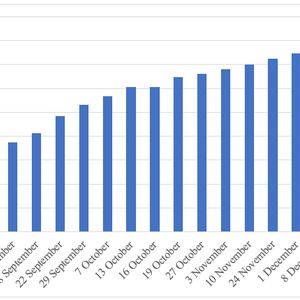
Summary Bitmine Immersion Technologies (BMNR) and SharpLink Gaming (SBET) are pioneering Ethereum treasury holders, shifting their business models to focus on ETH accumulation and staking. BMNR leads in scale with 4.1M ETH (3.41% of supply) and plans to reach 5%, while SBET emphasizes efficiency, DeFi partnerships, and share buybacks. I maintain a Buy rating for both BMNR and SBET, favoring SBET to mitigate dilution risk from BMNR’s upcoming share issuance. Investment Thesis As of today, Bitmine Immersion Technologies ( BMNR ) and SharpLink Gaming ( SBET ) hold the two largest Ethereum treasuries. The companies underwent a unique strategy of deep business model transformation in 2025, shifting away from their original focus (Bitcoin mining and gaming). As a result, the current growth of their shares is now directly linked to the prospects of Ethereum, but also to the potential for additional income from capitalizing on the digital token holdings on their balance sheets. This article aims to provide a detailed fundamental analysis of the similarities and differences between SBET and BMNR to answer a simple question: Can SharpLink take the lead in the battle with Bitmine for influence in the Ethereum network? Or is BMNR the undisputed analogue of Strategy ( MSTR ), meaning it will continue to lead in terms of spot Ethereum treasury accumulation? The practical interest in the fundamental analysis of these companies is also related to my personal experience in the crypto industry since 2017, due to which I remain optimistic in my assessments of the long-term development of the Ethereum network to this day. Fundamental similarities and differences between SBET and BMNR As SBET and BMNR pursue the same concept and have undergone a similar phase of profound transformation to become Ethereum treasury holders, they share the following fundamental similarities in their business profiles: Firstly, they are rightly called "pioneers" of a new corporate governance model, in which Ethereum is chosen as the reserve asset. Consequently, their share prices have a high beta to the volatility of the token price itself. Secondly, both are focused on integrating the Ethereum staking model to generate additional passive income. As a result, during a sideways and/or bear market, they are able to generate some additional revenue, enough to cover the companies' operating and administrative expenses. In the third place, institutional investors have shown increased interest in their shares (34.6% for SBET and 20.8% for BMNR), confirming the support of large capital in the stock market. And finally, we should note their overall trend of significant improvement in financial results, the previous negative trend continuing until 2024. The year 2025 saw an abnormal increase in net profit, possibly due to a profound transformation of the business. Even though SBET and BMNR have similar strategies and business models, if we dig deeper into their fundamental similarities, there are some things that make them different. First and foremost, these criteria relate to their scale and dominance on the Ethereum network. The main goal of Bitmine in accumulating digital tokens is to achieve a 5% ownership share of the total issuance. According to January 5, 2026, Ethereum's total issuance is 120.69 mln tokens. Therefore, a 5% stake would amount to 6.0345 mln digital tokens. Based on Bitmine's latest press release , they own approximately 4,110,525 ETH Ethereum tokens (purchased at an average price of $2,948), already accounting for 3.41% of the total cryptocurrency circulation on the network. Chart of ETH purchases for Bitmine reserves At SBET, these transactions are significantly smaller, since the company's balance sheet only has 860,000 Ethereum tokens. And despite this, both full Ethereum staking and selective DeFi are advantages of the strategy. In addition, the direct access to validators reduces staking fees, making the relationship more efficient by optimizing Ethereum deployment delays. So, if BMNR focuses on scale, then SBET focuses on quality and efficiency. Therefore, SharpLink manages to increase the turnover rate of tokens and improve their efficiency without capital expenditures on infrastructure. Nevertheless, the Bitmine management system's quality is enhanced by a completely different infrastructure approach that enables vertical integration. A proprietary network of nodes (MAVAN) will be launched in 2026, eliminating the need to pay commissions to third-party providers. Not only does this significantly reduce the cost of Ethereum staking, it also increases the security of the process and of token ownership/storage. The SBET has a different infrastructure building strategy, using an approach that relies on external solutions. It minimizes capital expenditures on digital equipment. But it makes the company's staking dependent not only on external validators and third-party technologies. Although the SBET has direct access in such relationships, it is still more expensive and less reliable. The significant difference between SBET and BMNR revolves around capital distribution policy. During the presentation of its Q3 2025 financial results, the management of Bitmine announced the first dividend payments among crypto companies holding digital tokens . The payments will amount to only $0.01 per share, or less than 0.03% in forward yield. However, this is still the first indication that treasury holders can pay dividends to their shareholders. And for BMNR, such a decision is a marketing move to increase excitement around its shares. At the same time, BMNR has a significant drawback related to its additional share issues. The process is necessary for subsequent purchases of Ethereum. On December 8, 2025, the management requested permission from shareholders for a large-scale additional issue of up to 50 bn shares . It could significantly dilute the shares of current shareholders and reduce the value of the securities themselves. The vote on this request will take place at the shareholders' meeting on January 15, 2026. The company cites not only additional purchases of Ethereum among the reasons for this decision, as well increased financial flexibility in the event of possible acquisitions. There is therefore even a possibility that BMNR may attempt to scale up its operations by acquiring other treasury holders. SBET has opted for a traditional share buyback strategy. Its current program is aimed at buying back shares worth up to $1.5bn. However, SharpLink's management cites increasing the efficiency of digital token storage and usage as its primary goal. It also aims to increase the share of Ethereum per remaining share. In my opinion, this decision has a significant advantage for shareholders. This is because the capital invested in SBET shares has every chance of paying off through an increase in this indicator. But the advantage of BMNR is its desire to scale up, which in the future could bring additional dividends through the implementation of new initiatives in the use of Ethereum. SBET and BMNR comparison table The table below shows a comparison of the main criteria, highlighting the differences between SBET and BMNR. Criteria SBET BMNR Basic strategy ETH-Based Corporate Treasury + Staking ETH proxy + Own validator network (MAVAN) ETH balance volume 860,000 ETH 4,110,000 ETH Infrastructure Partnerships (Consensys, EigenCloud) Own network (Made-in-America Validator) Dependence on counterparties High. Success depends on the stability of partners (Consensys, cloud providers). Low. Complete control over hardware and software. Risks are limited to the ETH protocol itself. Relationships with regulators Flexibility. They can quickly change staking jurisdictions or providers. Vulnerability. Large data centers in the US are an easy target for tax and environmental audits. Transparency of reporting Medium. Difficult to assess the risks of assets invested in DeFi. High. Traditional industrial-grade reporting (energy consumption, server uptime). P/NAV 0.95x 1.15х Share of institutional investors 34.60% 20.80% Quant Rating 2.75 3.40 SA Analysts Rating 4.00 3.81 Wall Street Rating 4.75 5.00 Market Cap $1.91B $13.28B Enterprise Value $1.89B $12.77B Short Interest 10.96% 6.49% Dividend Yield ( FWD ) 0.00% 0.03% Total Return, 1M -2.81% -1.27% Total Return, 3M -49.64% -50.65% Total Return, 6М -19.08% -46.67% Total Return, 1Y 19.93% 345.70% Comparing SBET and BMNR, there is no clear pattern in terms of overall profitability. The reason for this is that these companies announced their plans to implement the Ethereum treasury holder concept at different times. As a result, indicators covering periods of three months or less are the most reliable. Taking this particular time frame, SBET and BMNR's results are similar. If Bitmine's negative result was -50.65%, then SharpLink's was -49.64%. Total Return, 3M Risks of investing in SBET and BMNR Whether they choose SBET or BMNR, both companies' investors might face risks related to Ethereum price swings. They're super correlated because almost 100% of their income depends on the price of this token. As a result, a shift in Ethereum to a bear market phase could lead to huge paper losses. Nevertheless, based on my technical analysis of the higher time frames of the ETH-USD pair, I can identify a potential price reversal. On the 1W chart, there is a global upward trend channel. The lower boundary is currently above the key support zone ($2,112–$2,463). And it is this price zone that should prevent the asset from falling further. Given the current consolidation, it is likely that the price will head back up to the highs above the horizontal resistance line at $4,868. The alternative scenario suggests a correction to the lower boundary of the trend channel ($2,550), after which there will be a technical rebound in the price back up. Technical analysis of the Ethereum chart on the weekly timeframe. Source: TradingView Additionally, it is worth highlighting regulatory risk and centralization risk (especially for BMNR). In terms of regulation, it is unclear what status Ethereum will have in the future in the US jurisdiction, since this will determine the future rules for validators participating in the staking program. With regard to the risk of centralization, the point here is that achieving BMNR's goal could lead to one company owning a huge amount of Ethereum. This is unacceptable to the crypto community, since the original goal was to decentralize the Ethereum network. Furthermore, the presence of a larger share of tokens on BMNR's balance sheet could lead to the company's financial problems causing the price of ETH-USD to fall. And this, in turn, will further exacerbate Bitmine's financial problems. As a result, a vicious circle emerges, which could become a challenge for BMNR and the crypto community in the future. Conclusion Therefore, the results of the comparative analysis between SBET and BMNR allow us to identify differences between them, which, although not significant, still lead to different assessments. While SBET is a more flexible company that can provide additional returns through DeFi partnerships and is focused on share buybacks, the BMNR is a giant and leader in the Ethereum treasury holding segment. It makes it something of a "state validator" for Ethereum, planning to stake digital tokens through its own network of American validators. The result is that the company began paying dividends in Q3 2025. At the same time, however, BMNR has a significant drawback, namely the frequent issuance of shares, with the proceeds used to make additional purchases of Ethereum. If the decision on January 15 is positive for the additional issue of up to 50 bn shares, it could become a "trap" for Bitmine investors in the long term. Previously, my recommendation for BMNR was "Buy," and given the current price situation for Ethereum, I maintain this recommendation. But SBET shares look no less promising to me. So, if you have free capital, I would recommend adding SharpLink shares to your portfolio, with a recommendation to "Buy" them as well. For me, the choice of SBET over BMNR is primarily motivated by an attempt to avoid the risks of Bitmine’s additional share issue in 2026.